


The Authentic Theory of Evolution Contains No Inspirational Elements
Content Summary:The genuine theory of evolution lacks any motivational elements. Evolution is driven by random genetic mutations and environmental natural selection, unrelated to effort or strength. Misunderstanding evolution as "survival of the fittest" ignores the importance of adaptation and cooperation over competition. Genetic drift, more common than natural selection, contributes to the diversity of life by allowing non-competitive traits to persist. Innovation and creativity, rather than relentless competition, drive evolution and progress. The outdated notion of constant competition undermines the potential for invention and development, emphasizing the need for a broader understanding of evolutionary principles.

The inspirational content of the authentic theory of evolution is zero.
The core idea of evolutionary theory is random genetic mutation and natural selection by the environment. Whether an organism's next generation turns out one way or another is entirely the result of random genetic mutation and has nothing to do with "effort." It's not that if you try hard, you will become stronger, or if you want to grow taller, you will grow taller. Genetic mutation is not something that can be influenced by subjective efforts.
Moreover, evolutionary theory does not specifically exalt "strength." Whether a mutation can survive and spread depends on its adaptation to the environment, not its "strength." If the environment requires you to be a predator, then indeed, the stronger and faster, the better. But if the environment is harsh and requires frequent hiding, then being low-key might be more advantageous for survival, such as through mimicry, playing dead, being nocturnal, or living in small burrows.
Essentially, a species' adaptability is reflected not in competition with other species, but in its adaptation to the environment, which includes other species but also factors like climate, water, and temperature. For example, the most influential factor for sheep is not wolves, but grass.
Natural selection is not driven by a worship of strength.
Misinterpreting evolutionary theory as "natural selection, survival of the fittest" means seeing only competition and not cooperation. In nature, besides competitive relationships, there are many—perhaps even more—symbiotic relationships. Bees collect nectar and help pollinate flowers; cleaner fish eat parasites and dead skin off larger fish, helping them stay healthy; hermit crabs, lacking a hard shell, host sea anemones on their bodies: sea anemones provide protection, and hermit crabs offer mobility...
There is both competition and cooperation. The weak don't necessarily have to be beaten; the main focus is not on outdoing opponents but on solving broader survival and development issues. This genuine picture of evolutionary theory not only resembles the relationships between companies in a market but also the relationships between countries in international politics.
Thus, mainstream narratives at home and abroad no longer use "natural selection, survival of the fittest" for inspiration. Evolutionary theory is no longer as readily absorbed by the public. However, drawing analogies between evolution and market competition remains attractive. Some entrepreneurs, like Ray Dalio, enjoy using evolutionary theory to explain the survival strategies of businesses.
This analogy is not fundamentally flawed.
Two AI experts, Kenneth Stanley and Joel Lehman, published a book in 2015 called Why Greatness Cannot Be Planned, which explains innovation from the perspective of AI algorithms. As a byproduct, they reinterpreted evolutionary theory.
Biologists present, please be patient; these two have neither overturned evolutionary theory nor claimed it was wrong. The facts remain the same, but interpretations of those facts can be subjective.
There is a branch of AI engineering that invents new algorithms by simulating the evolution of life, and these two have done the same. They gained insights from AI evolution, which in turn fed back into evolutionary theory.
Natural selection is about survival and reproduction. Genes conducive to survival and reproduction are more likely to be passed on, while those detrimental are more likely to be eliminated; this is all correct.
The problem arises when some people silently assume that living organisms are constantly busy with survival and reproduction and that any trait or gene that gets passed down must be beneficial for these purposes. This is the second misunderstanding.

In reality, many genes that have little to do with survival and reproduction, or are even harmful, also get passed down. For example, variations in blood types among different populations, eye color differences, susceptibility to different genetic diseases, lactose tolerance or intolerance—these differences arose randomly. The traits and genes that constitute these differences have little impact on survival and reproduction, so natural selection did not intervene, allowing them to arise.
This phenomenon is called "genetic drift." The theory might have first been proposed as early as 1929 and is now accepted by mainstream academia.
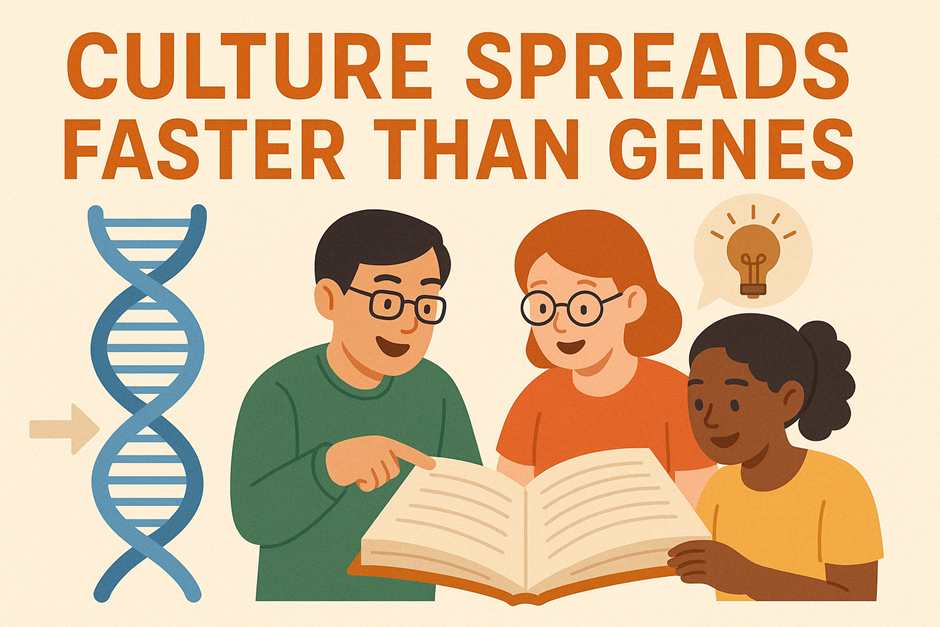
Stanley and Lehman’s insight is that genetic drift is actually more prevalent than natural selection: organisms evolve in various directions not to adapt to natural selection—they evolve because they can. It is not natural selection driving biological diversity, but natural selection allowing for it.
In essence, the reason for the diversity of life is that natural selection often didn’t intervene.
If survival and reproduction were the sole goals of evolution, Earth should be dominated by lower organisms, as they have already solved these problems effectively. The presence of higher organisms is due to life’s tendency to mutate in all directions; they are inherently changeable.
A change's success often isn't because it intensifies competition, but because it enables the organism to avoid competition. For example, moving from the ocean to land, suddenly being able to digest previously inedible food, or acquiring the ability to fly—these organisms left their original competitive "red ocean" to explore a new ecological niche, enjoying a "blue ocean" existence.
In entrepreneurial terms, this is called "going from 0 to 1" or "creating a new track."
In reality, the biological world is not in constant, fierce competition. If it were, organisms would be too exhausted to evolve all the beautiful and strange elements we see. The world’s diversity arises because competition is localized, and new niches are waiting to be explored, allowing organisms the leisure to drift in directions that do not necessarily enhance competitiveness.
Thus, Stanley and Lehman argue that to evolve into a distinctive species, competitive pressure must not overshadow the drive for creativity.
Consider if this applies to markets and societies. If you have to work ten hours a day just to feed yourself, you won’t think about science or art, nor will you innovate. Only with enough leisure, money, and a sense of security can you afford to engage in whimsical inventions.
There is a saying, "A focus on competition weakens competitiveness," and its fundamental principle lies here. Creativity stems more from freedom than from competition.
Understanding evolution vulgarly as "adapt or be eliminated" and always thinking about "fitting in" and "making it" leads to mediocrity. Yes, poor children may mature early; but rich children are more likely to become inventors.
It’s like the game Minecraft: your company constantly pushes employees to work overtime in a "survival mode," while more advanced companies play in "creative mode."
If you can’t find a good niche due to constraints, that’s one thing; but if you have resources and still create internal friction, that’s outdated thinking.
To those still clinging to "natural selection" and "backwardness means being beaten" ideologies, even Putin talks about "win-win cooperation" nowadays.
To those who view all activities as struggles for survival and reproduction, do you know that even the animal world doesn’t operate that way?


Comments